
Workshop
Sing and move / Games with body and voice
Noé Pellencin
- Dates
- Sunday 24 May, 14:30
- Duration
- 120 min.
- Language
- French, with Dutch translation.
- Age
- This workshop is suitable for ages 8 and up. Children aged 8–12 must be accompanied by an adult.
- Reservation
- This is a workshop with limited capacity. Please reserve your spot when purchasing your ticket.
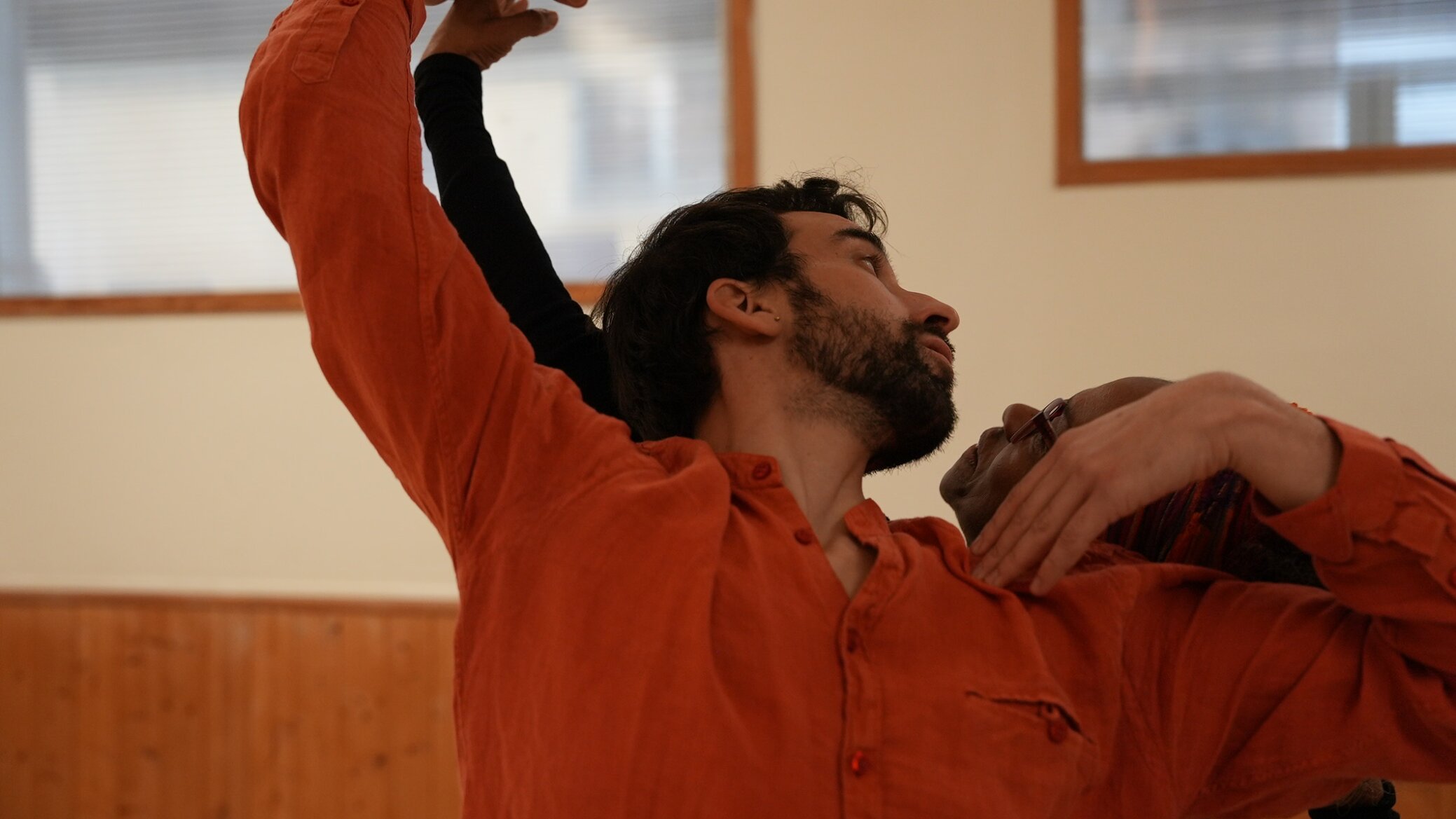
In this workshop, participants are invited to explore the connections between voice, gesture, and speech through simple, accessible games. Inspired by the creative process of Souvent en de lents déjeuners…, the session encourages everyone to experiment with how a sound can become a gesture, how a gesture can unfold into a phrase, or how words can transform into rhythm. Differences of age, culture, and sensitivity are not obstacles but sparks for shared creativity, as participants discover the joy of daring, listening, and playing together.
The workshop unfolds as a series of playful transformations: starting from an impulse (a song, rhythm, word, or movement), participants respond and let their ideas rebound into new forms. Each proposal is met with collective improvisation, surprise, and humor. Step by step, small groups invent mini-presentations that highlight mutual inspiration and the pleasure of collective invention. No previous experience in dance, singing, or theatre is needed: the emphasis lies on accessibility, intergenerational exchange, and the joy of discovering that every voice, every body, and every word can become part of a creative fabric.
Noé Pellencin
Noé Pellencin was trained in classical and contemporary dance at the Conservatoire National Supérieur de Musique et de Danse de Lyon, and later at P.A.R.T.S. in Brussels. As a performer, he has collaborated with choreographers such as Boris Charmatz, Maud Le Pladec, and Fabrice Lambert, touring internationally from 2016 onwards. Alongside his career as an interpreter, he co-founded the association MOSAE in 2024, through which he creates projects at the intersection of art, pedagogy, and social engagement.
His artistic approach is enriched by his practice of Aïkido (2nd dan), which informs his understanding of flow, adaptability, and relational dynamics in movement. He also deepens his relationship to rhythm and musicality through the O Passo method, which grounds his choreographic work in embodied listening and collective rhythm-making. His research emphasizes improvisation and the collective dimension of movement, where the body is less a site of virtuosity than a medium for exchange, dialogue, and shared imagination.